
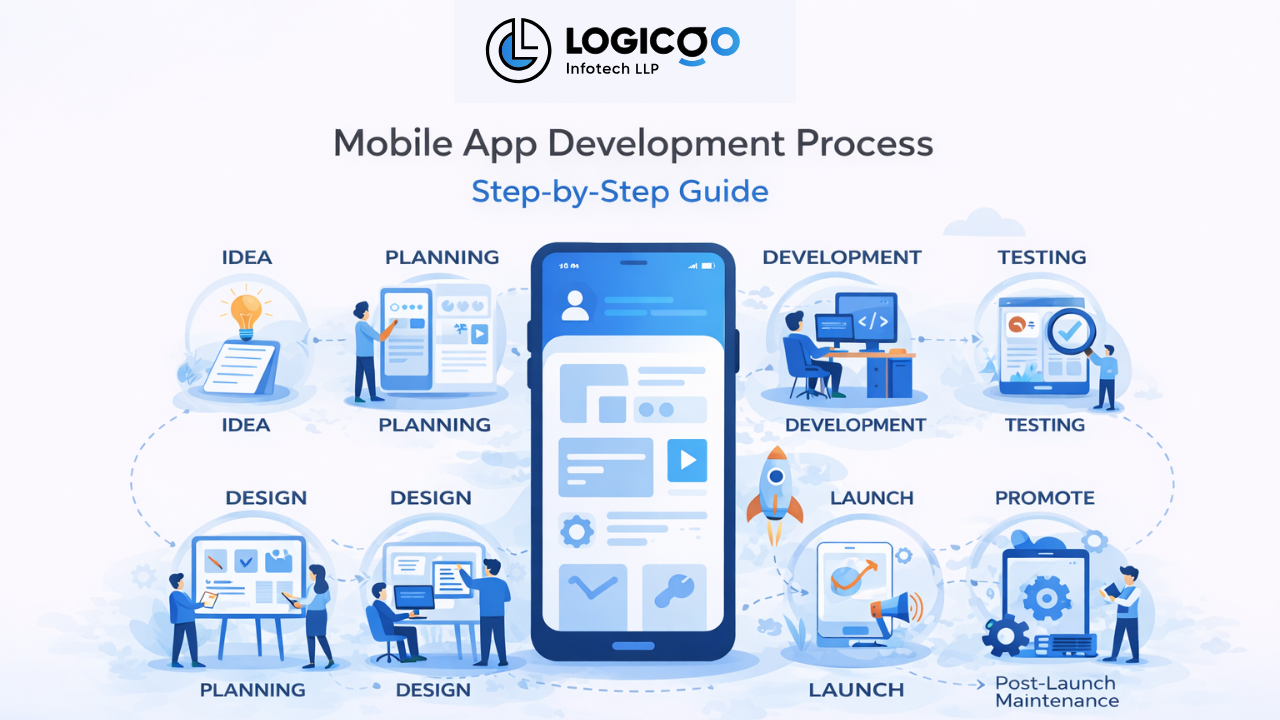
Learn the complete mobile app development process step by step. From idea validation to app launch and maintenance, discover how successful apps are built.
Introduction
In today’s digital-first world, mobile applications play a crucial role in business growth, customer engagement, and brand visibility. However, building a successful mobile app requires more than just a good idea. It demands a structured, strategic, and well-executed mobile app development process.
Understanding each stage of the app development journey helps businesses reduce risks, control costs, and ensure high-quality results. In this step-by-step guide, we’ll walk you through the complete mobile app development process, from concept to launch and beyond.
Step 1: App Idea & Requirement Analysis
Every successful mobile app begins with a clear idea and defined objectives. At this stage, businesses identify the purpose of the app and the problem it aims to solve.
Key Activities:
- Define business goals and target audience
- Identify core features and functionalities
- Analyze competitors and market demand
- Choose the app type (business, eCommerce, social, on-demand, etc.)
A detailed requirement analysis ensures the app aligns with user expectations and business objectives from the start.
Step 2: Market Research & Feasibility Study
Before moving into development, it’s essential to validate the idea. Market research helps determine whether the app concept is viable and competitive.
This step includes:
- Understanding user behavior and pain points
- Identifying market gaps and opportunities
- Technical feasibility assessment
- Budget and timeline estimation
This stage helps businesses avoid costly mistakes and ensures the app has real market demand.
Step 3: App UI/UX Design
User experience (UX) and user interface (UI) design play a critical role in app success. A visually appealing and easy-to-use app increases user engagement and retention.
Design Process:
- Wireframing to outline app structure
- Creating interactive prototypes
- Designing intuitive navigation and layouts
- Ensuring platform-specific guidelines (iOS & Android)
A strong UI/UX design focuses on simplicity, usability, and consistency to deliver a seamless user experience.
Step 4: App Development (Frontend & Backend)
This is where the actual coding begins. The development phase is usually divided into frontend and backend development.
Frontend Development:
- Builds the visual elements users interact with
- Ensures smooth navigation and responsiveness
Backend Development:
- Handles databases, servers, APIs, and security
- Manages user authentication and data processing
Depending on business requirements, developers choose native app development or cross-platform app development to ensure optimal performance.
Step 5: Quality Assurance & Testing
Testing is a critical step in the mobile app development process. It ensures the app functions correctly across different devices and platforms.
Types of Testing:
- Functional testing
- Performance testing
- Security testing
- Usability testing
- Compatibility testing
Thorough testing helps identify bugs, performance issues, and security vulnerabilities before launch.
Step 6: App Deployment & Launch
Once testing is complete, the app is ready for deployment. This step involves submitting the app to app stores and preparing it for public release.
Deployment Includes:
- App Store (iOS) submission
- Google Play Store (Android) submission
- App store optimization (ASO)
- Compliance with platform guidelines
A smooth launch ensures the app reaches users without technical or approval issues.
Step 7: Post-Launch Support & Maintenance
Launching the app is not the end of the process. Continuous maintenance and updates are essential for long-term success.
Post-Launch Activities:
- Monitoring app performance and user feedback
- Fixing bugs and improving features
- Regular security updates
- Adding new functionalities
Ongoing support helps keep the app competitive, secure, and aligned with evolving user needs.
Why Choose a Professional Mobile App Development Company?
Partnering with an experienced mobile app development company ensures a structured approach, technical expertise, and scalable solutions. Professional teams follow industry best practices, maintain quality standards, and deliver apps that drive real business results.
At LogicGo Infotech, we provide end-to-end mobile app development services, from idea validation to deployment and ongoing support, tailored to your business goals.
Extra Tip:
The mobile app development process is a journey that requires careful planning, skilled execution, and continuous improvement. By following a step-by-step approach, businesses can build high-performing, user-friendly mobile apps that deliver value and growth.
Whether you’re planning a new app or upgrading an existing one, understanding this process helps you make informed decisions and achieve long-term success.
Looking to build a custom mobile app for your business?
Get in touch with LogicGo Infotech today and turn your app idea into a powerful digital solution.